


Blog /
100 percent Bonus Depreciation for business jets planned to end in 2022
Bonus depreciation is a tax incentive that allows business owners to report a larger percentage of depreciation in the year the asset, such as an aircraft, was purchased and placed in service.

As the law stands, you can deduct up to 100% of an asset’s cost in the year of purchase on your business taxes although not all assets are eligible, and there are restrictions: One factor that needs to be considered when buying a business jet is what qualifies for the bonus depreciation since jets purchased mainly for personal or leisure travel will not be eligible. Private jets must be used for business for a minimum of 51%.
The Outlier Jets Team is uniquely positioned to ensure those considering aircraft ownership have the appropriate tax planning team in place, as well as what to expect when acquiring an aircraft.
TIME LIMITATION
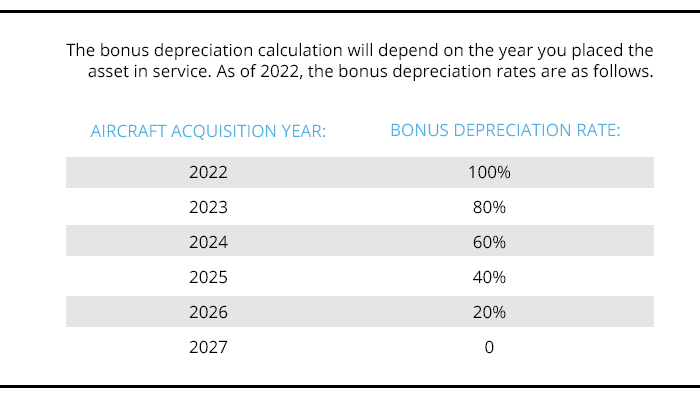
As part of the Tax Cuts and Jobs Act of 2017, the tax incentive tapers to 80 percent from the 1st January 2023 which means anyone wishing to claim the tax deduction will have to complete the transaction before the end of the year to claim the 100% bonus depreciation.
The Outlier Team can advise buyers how to complete the transaction efficiently and in good time. Current challenges within the industry, such as long waits with pre-buy inspection firms or with the FAA may mean more time is required than anticipated.
MACRS
Under normal circumstances, first-time owners favor the more traditional, modified accelerated cost recovery system (MACRS) schedule. The MACRS depreciation method permits greater deductions in the initial years of an asset's life, and smaller deductions in later years. Depending on individual or corporate use, depreciation may be five to seven years or as long as 12 years. Any established broker with knowledge and experience should be able to advise buyers on the correct approach.
BACKLOG ORDERS & DELIVERY TIMES
OEM suppliers need to meet the demand for new aircraft but are delayed by shortages of semiconductor chips, plastics, steel and aluminum in addition to the restricted supply from countries like Russia for nickel and titanium. Backlogs and wait times for new aircraft are often averaging up to two years from the major OEM’s- such as Bombardier, Gulfstream, and Textron.
In Q2 2022, Bombardier has reported a swell in backlog orders that have reached a historical level while Embraer reported its highest order backlog since the start of the pandemic; its firm order backlog reached $17.8 billion in the second quarter, up 3% compared with the first quarter and a year-on-year increase of 12%. The high demand for new jet aircraft coupled with a limited supply of raw materials create delivery times of a 12-18 month timeframe between contract and delivery.
As a result, prices are up. The aviation industry on average paid 27% to 44% percent more for raw materials in 2021 compared to 2020, according to data from consulting firm AlixPartners.
MANUFACTURERS MEASURED APPROACH
Even as sales orders poured in and backlogs ballooned last year, OEMs were reluctant to increase production until several consecutive quarters of confirmed sales were seen. Events such as the Great Recession of 2008 proved that over-production can create a surplus of unsold inventory very quickly which requires years to recover to a normal inventory level.
Consequently, today manufacturers are being more measured this time in their approach to increasing production, preferring initially to decrease discounts and raise prices to improve margins.
In 2022 Gulfstream only plans to roughly match last year’s shipment level and similarly, Bombardier has decided not to take steps towards increased output just yet.
POSSIBLE HEADWINDS
Nevertheless, this recent history does not reflect the present market influences. For the coming year, headwinds - the Fed's monetary policies, inflation reaching near 10% recently, jet A fuel over 300% of historical averages, oscillating capital markets and a 20% YTD sell-off will be more prominent and directly related to the global economy.
A BRIGHT FUTURE
Notwithstanding, Outlier Jets sees a promising outlook for aircraft owners. The opportunity to subsidize ownership costs via Part 135 charter has never seen higher demand. As an owner, the charter subsidies are also at all time highs- allowing an owner to enjoy their asset and offset much of their cost.
The close of the year will certainly bring individuals and corporations to the table, seeking an opportunity to benefit from the tapering tax incentives and likely acquiring in the secondary market.

September 29, 2022


